

Greenwashing or genuine sustainability?
In a sea of brands that call themselves “green,” it’s becoming increasingly difficult to distinguish the true champions of environmental protection from those who merely claim to be. We want to shed light on the topic of RPET (recycled PET) in particular. Is it a savior of the environment, or is it actually a secret polluter? We explain why we’re committed to RPET despite certain challenges.
What is RPET? How is it made?
RPET stands for Recycled Polyethylene Terephthalate—or simply put: recycled plastic. In the textile industry, high-quality fibers and yarns are produced from used plastic bottles and containers. Old plastic that would otherwise end up in landfills is collected, cleaned, and shredded into pieces. The material is then melted down and processed into new fibers, which we use for our towels.

It is important to note that RPET has only been “mass-market ready” for a few years. The technology ensures that new products are created from old plastic—and with significantly less energy and resources than are required to produce new polyester. Thus, RPET remains a material that helps reduce the amount of plastic waste while minimizing resource consumption. However, there are also critical issues. More on this in the next section.
The biggest challenge of RPET: microplastics
One challenge with RPET—and with synthetic fabrics in general—is the release of microplastics during washing. Fine fibers detach from the material and can end up in wastewater. How does this apply to WOODSANDWAVES towels? Let’s get to the bottom of it.
The key lies in the quality of the yarn. Our towels are made from high-quality RPET yarn. Why is that important? The better the quality of the yarn, the fewer fibers come loose during washing. That’s why we rely on strict controls and high quality to ensure that our products meet the highest standards and release minimal microplastics. We’ll explain why we use RPET in the first place in a moment.
But what also helps is the nature of our towels themselves. They are stain- and sweat-resistant and have sand-repellent properties. This keeps your towel clean, hygienic, and usable for a long time, so it needs to be washed less often. And when it does, a cold wash—which releases fewer microplastics—is sufficient. We label the towels so that they should be washed at a maximum of 30 degrees. Although they could withstand higher temperatures, this would not be beneficial for minimizing microplastic release and ensuring the towels’ longevity.
We know that the issue of microplastics is complex. But we firmly believe that the advantages of RPET in terms of functionality and manufacturing—less waste, lower energy consumption—outweigh those of other synthetic materials.
Why synthetic fabrics instead of cotton in the first place?
Microfiber towels made from synthetic materials offer a range of special features that make them an ideal companion—they are lightweight, compact, durable, quick-drying, and sand-repellent.

Microfiber towels are incredibly versatile. We also hope that this might lead people to buy fewer products, since a WOODSANDWAVES towel covers so many uses. It’s ideal for the beach, the park, and travel. You can use it to dry off after swimming, as a yoga mat, or to wipe away sweat while hiking.
At the same time, sustainability is a core concern for us. We always keep a close eye on new developments and materials and are ready to explore alternative options as soon as they offer the same level of functionality and sustainability as synthetic fabrics.
It is also important to note that cotton is not necessarily the more environmentally friendly choice. Cotton cultivation requires large amounts of water, pesticides, and fertilizers, which can have a negative impact on the environment.
What can our customers do to avoid or reduce microplastics?
Reducing microplastics is important to us. As a WOODSANDWAVES customer, you can also do your part by washing your towels less often. It’s not necessary to wash the towel after every use. WOODSANDWAVES towels are extremely durable and, thanks to the high quality of the yarn, stay clean and hygienic for a long time.
If you need to wash the items, it is best to use a low wash temperature and eco-friendly detergents.
But for those who still feel this isn’t enough (despite very low microplastic emissions), we’d appreciate it if you used our Guppyfriend laundry bag when doing laundry. Thanks to our partnership with Guppyfriend, virtually all microplastic particles are filtered out during washing.
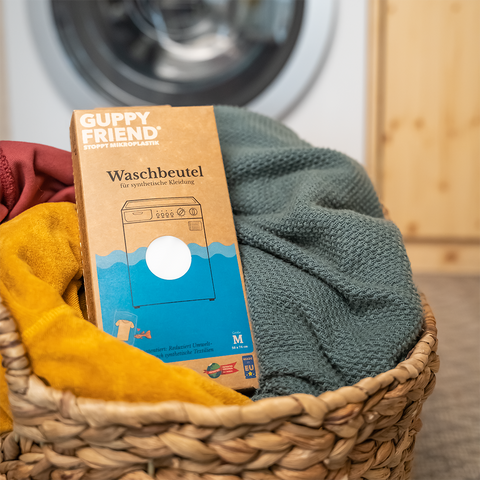
The GUPPYFRIEND wash bag was developed in collaboration with scientists and is made from a durable, fine-mesh fabric.
Another advantage of the laundry bag is that the towels are generally washed more gently inside it. This puts less strain on the material, and the towel lasts even longer when used correctly.
At WOODSANDWAVES, we believe that every small step in the right direction counts, and the GUPPYFRIEND toiletry bag is one of them.